Fast and Scalable FFT-Based GPU-Accelerated Algorithms for Hessian-Vector Products Arising in Inverse Problems Governed by Autonomous Dynamical Systems


Forward Problem
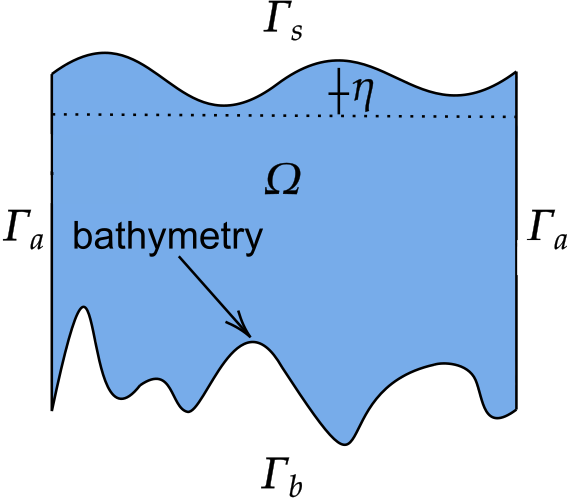
Coupled Acoustic-Gravity wave equations:
Velocity: \(\boldsymbol{u}(\boldsymbol{x}, t)\), Pressure: \(p(\boldsymbol{x}, t)\),
Surface Height: \(\eta(\boldsymbol{x}, t)\)
Forward Problem
Coupled Acoustic-Gravity wave equations:
\[\begin{cases} \rho \frac{ \partial\boldsymbol{u}}{\partial t} + \nabla p = \boldsymbol{0}, \frac{1}{K} \frac{ \partial p}{\partial t} + \nabla \cdot \boldsymbol{u} = 0, & \Omega \times (0,T)\nonumber\\ p = \rho g \eta, \frac{ \partial\eta}{\partial t} = \boldsymbol{u} \cdot \hat{\boldsymbol{n}}, & \Gamma_s \times (0,T) \nonumber\\ \boldsymbol{u} \cdot \hat{\boldsymbol{n}} = -\frac{\partial b}{\partial t}, & \Gamma_b \times (0,T) \nonumber\\ \boldsymbol{u} \cdot \hat{\boldsymbol{n}} = Z^{-1} p, & \Gamma_a \times (0,T)\nonumber \end{cases} \]
bulk modulus \(K\), density \(\rho\), \(Z = \rho c\), \(c = \sqrt{K/\rho}\)
bathymetry \(b(\boldsymbol{x}, t)\); Homogeneous ICs
Definitions
Inverse Problem: given observations, estimate model parameters (with quantified uncertainty)
Bayesian Inverse Problem
Goal: determine posterior measure \(\mu_{\text{post}}\)
\(m\): model parameters - spatiotemporal field,
\(d\): obs. data - pointwise space,
continuous time
Bayes Rule:
\(\frac{\text{d}\mu_{\text{post}}}{\text{d}\mu_{\text{prior}}} \propto
\pi_{\text{like}}(d|m) \)
\(=\exp\left(-\frac{1}{2}\|\mathcal{F}m - d\|_{\Gamma_{\text{noise}}^{-1}}^2\right)\) (in our case)
Parameter-to-Observable (p2o) Map:
\(\mathcal{F}: m \mapsto
d\)
Linear Inverse Problem, Gaussian Prior
Prior: \(m \sim \mathcal{N}(m_{\text{prior}}, \Gamma_{\text{prior}})\)
Observations: \(d = \mathcal{F}m + \nu\), \(\nu \sim \mathcal{N}(0, \Gamma_{\text{noise}})\)
Posterior: \(\mu_{\text{post}} = \mathcal{N}(m_{\text{map}}, \Gamma_{\text{post}})\)
\[\begin{gather} \Gamma_{\text{post}}=\left(\mathcal{F}^* \Gamma_{\text{noise}}^{-1} \mathcal{F} + \Gamma_{\text{prior}}^{-1}\right)^{-1} \nonumber\\ m_{\text{map}}=\Gamma_{\text{post}}\left(\mathcal{F}^* \Gamma_{\text{noise}}^{-1} d + \Gamma_{\text{prior}}^{-1} m_{\text{prior}}\right) \nonumber \end{gather}\]
Linear Inverse Problem, Gaussian Prior
\[\begin{gather} \Gamma_{\text{post}}=\left(\mathcal{F}^* \Gamma_{\text{noise}}^{-1} \mathcal{F} + \Gamma_{\text{prior}}^{-1}\right)^{-1} \nonumber\\ m_{\text{map}}=\Gamma_{\text{post}}\left(\mathcal{F}^* \Gamma_{\text{noise}}^{-1} d + \Gamma_{\text{prior}}^{-1} m_{\text{prior}}\right) \nonumber \end{gather}\]
Want to find \(m_{\text{map}}\) and \(\Gamma_{\text{post}}\) in real-time
Stuart, Andrew M. "Inverse problems: a Bayesian perspective." Acta numerica 19 (2010): 451-559.
Finding the MAP Point
\(\Gamma_{\text{post}}^{-1} =: \mathcal{H} \) is the Hessian (of negative log-posterior)
Each Hessian action \(\mathcal{H}v\) requires 1 Forward PDE Solve and 1 Adjoint PDE Solve (traditionally)
Solving \( \mathcal{H}m_{\text{map}} = \mathcal{F}^* \Gamma_{\text{noise}}^{-1} d + \Gamma_{\text{prior}}^{-1} m_{\text{prior}} \) with CG requires \(\text{rank}(\mathcal{H})\) Hessian actions
Ghattas, Omar, and Karen Willcox. "Learning physics-based models from data: perspectives from inverse problems and model reduction." Acta Numerica 30 (2021): 445-554.
Finding the MAP Point
For hyperbolic systems, \(\mathcal{H}\) can have high rank \(\Rightarrow\) many PDE solves
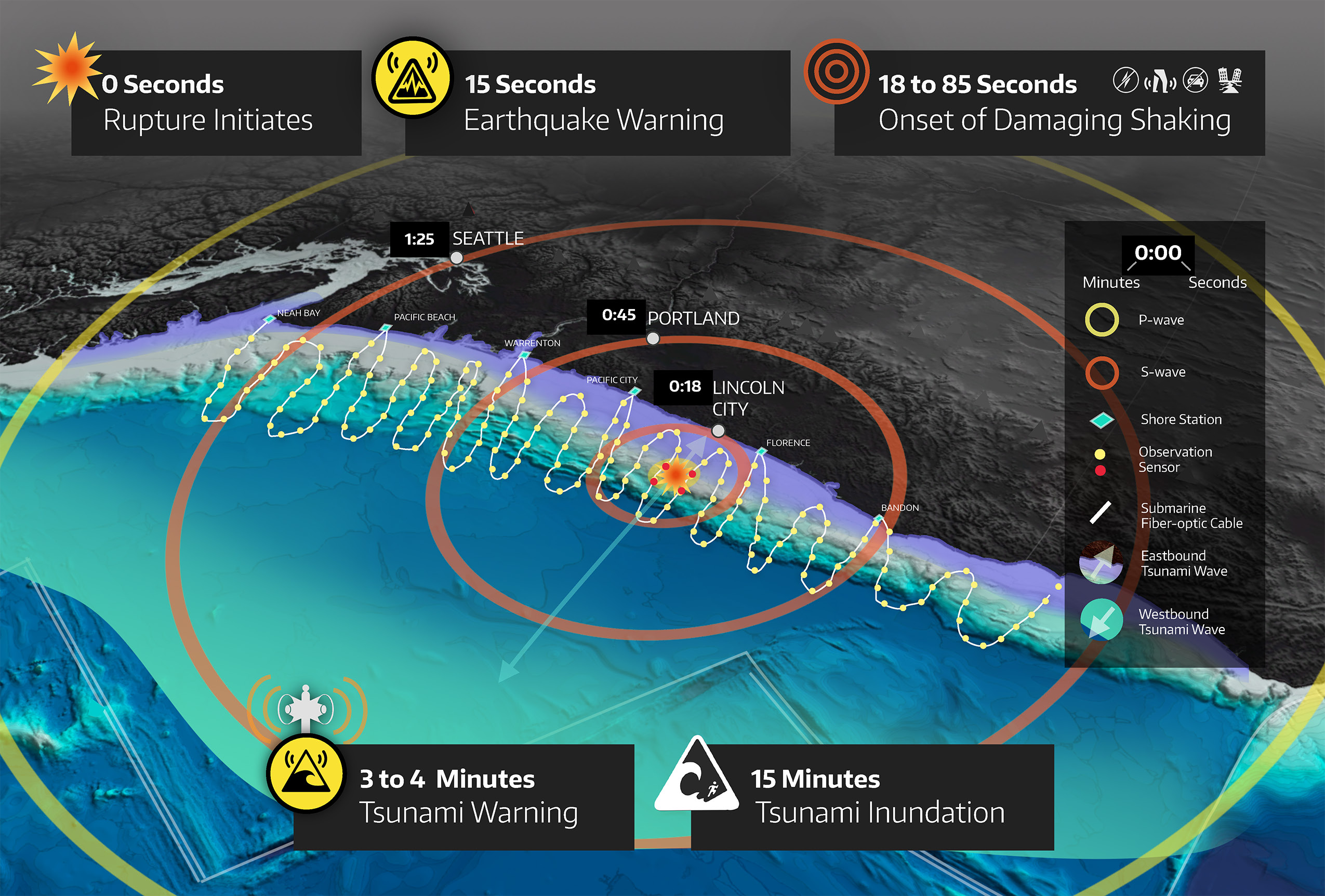
Cascadia Tsunami Problem:
\(\text{dim}(\mathbf{m}) \sim
10^{10},
\text{dim}(\mathbf{d}) \sim 10^6, N_t \sim 10^4\)
\(\Rightarrow\) \(\text{rank}(\mathbf{H}) \sim 10^4\)
\(\sim\) 1 hour / Hessian application \(\Rightarrow\) over 1 year (on thousands of nodes) for CG to converge!
Useless. We need to find the MAP point in seconds.
Definitions
Inverse Problem: given observations, estimate model parameters (with quantified uncertainty)
Autonomous Dynamical System: evolution does not depend explicitly on independent variable (e.g. time)
Real-Time Inference
Split computations into Offline and Online phases
Exploit (time) shift-invariance of autonomous dynamical systems
Real-Time Inference
Phase 1 (Offline): Construct p2o map from adjoint PDE solves
Phase 2 (Offline): Compute compact representation of \(\Gamma_{\text{post}}\)
Phase 3 (Online): Compute MAP point in real-time
Real-Time Inference
Phase 1 (Offline): Construct p2o map from adjoint PDE solves
Phase 2 (Offline): Compute compact representation of \(\Gamma_{\text{post}}\)
Phase 3 (Online): Compute MAP point in real-time
Real-Time Inference
Phase 1 (Offline): Construct p2o map from adjoint PDE solves
Recall: \( \mathbf{H} = \mathbf{F}^* \Gamma_{\text{noise}}^{-1} \mathbf{F} + \Gamma_{\text{prior}}^{-1}\)
shift-invariance \(\Rightarrow\) \(\mathbf{F}\) is block lower-triangular Toeplitz
Real-Time Inference
Phase 1 (Offline): Construct p2o map via adjoint solves
shift-invariance \(\Rightarrow\) \(\mathbf{F}\) is block lower-triangular Toeplitz
\(\mathbf{F}\)
→
\(\mathbf{F}\)
→
\(\mathbf{F}\)
↝
\(\mathbf{F}^*\)
Real-Time Inference
Phase 1 (Offline): Construct p2o map via adjoint solves
shift-invariance \(\Rightarrow\) \(\mathbf{F}\) is block lower-triangular Toeplitz
\(\mathbf{F}\)
→
\(\mathbf{F}\)
→
\(\mathbf{F}\)
↝
\(\mathbf{F}^*\)
Only one block row of \(\mathbf{F}^*\) needs to be computed/stored!
Real-Time Inference
Phase 1 (Offline): Construct p2o map from adjoint PDE solves
shift-invariance \(\Rightarrow\) \(\mathbf{F}\) is block lower-triangular Toeplitz
\(\mathbf{F}\)
Real-Time Inference
Phase 1 (Offline): Construct p2o map from adjoint PDE solves
shift-invariance \(\Rightarrow\) \(\mathbf{F}\) is block lower-triangular Toeplitz
\(\mathbf{F}\)
Real-Time Inference
Phase 1 (Offline): Construct p2o map from adjoint PDE solves
shift-invariance \(\Rightarrow\) \(\mathbf{F}\) is block lower-triangular Toeplitz
\(\mathbf{F}\)
Real-Time Inference
Phase 1 (Offline): Construct p2o map from adjoint PDE solves
shift-invariance \(\Rightarrow\) \(\mathbf{F}\) is block lower-triangular Toeplitz
\(\mathbf{F}^*\)
Only one block row of \(\mathbf{F}^*\) needs to be computed/stored!
Real-Time Inference
Phase 1 (Offline): Construct p2o map from adjoint PDE solves
\(\mathbf{F}^*\)
Only one block row of \(\mathbf{F}^*\) needs to be computed/stored!
Adjoint PDE solved backwards in time with "source" at each observation point (\(\sim\)100 sensors)
Real-Time Inference
Phase 2 (Offline): Compute compact representation of \(\Gamma_{\text{post}}\) (through Sherman-Morrison-Woodbury)
Phase 3 (Online): Compute MAP point in real-time
Both rely on fast applications of \(\mathbf{F}\) and \(\mathbf{F}^*\)
Matvecs with Block Triangular Toeplitz Matrices
\(\mathbf{F} \) has \(N_t \times N_t\) blocks
Each block is \(N_d \times N_m\)
This is time-outer, space-inner indexing
Preprocessing: Reindex to space-outer, time-inner
Matvecs with Block Triangular Toeplitz Matrices
Preprocessing: Reindex to space-outer, time-inner
\(\mathbf{F} \) now has \(N_d \times N_m\) blocks
Each block is \(N_t \times N_t\)
Cascadia: \(N_d \sim 10^2, N_m \sim 10^{6}, N_t \sim 10^4\)
Matvecs with Block Triangular Toeplitz Matrices
Preprocessing: Reindex to space-outer, time-inner
\(\mathbf{F} \) now has \(N_d \times N_m\) blocks
Each block is \(N_t \times N_t\)
Each block of \(\mathbf{F} \) is now a lower-triangular Toeplitz matrix
Matvec Algorithm
Toeplitz matrix \(A\) is represented by its first column \(a_0\)
Embed \(A\) in a circulant matrix \(C\)
\(a_0\mapsto [a_0 \ \mathbf{0}]^T =: c_0\) (zero padding)
Input vector \(v \mapsto [v \ \mathbf{0}]^T =: u\)
\(C\) is diagonalized by the Fourier Transform
\(Cu = \text{IFFT}\left(\frac{1}{\sqrt{2n}} \text{FFT}(c_0) \odot \text{FFT}(u)\right)\)
\(Av\) is the first half of \(Cu\)
Matvec Algorithm
Toeplitz matrix \(A\) is represented by its first column \(a_0\)
Embed \(A\) in a circulant matrix \(C\)
\(a_0\mapsto [a_0 \ \mathbf{0}]^T =: c_0\) (zero padding)
Input vector \(v \mapsto [v \ \mathbf{0}]^T =: u\)
\(C\) is diagonalized by the Fourier Transform
\(Cu = \text{IFFT}\left(\frac{1}{\sqrt{2n}} \text{FFT}(c_0) \odot \text{FFT}(u)\right)\)
\(Av\) is the first half of \(Cu\)
Example
\(A = \begin{bmatrix} 1&0&0&0\\2&1&0&0\\3&2&1&0\\4&3&2&1\end{bmatrix}, v = \begin{bmatrix}5\\6\\7\\8\end{bmatrix}\)
\(a_0 = [1\ 2 \ 3 \ 4]^T \to [1\ 2\ 3\ 4\ 0\ 0\ 0\ 0]^T = c_0\)
\(u = [5\ 6\ 7\ 8\ 0\ 0\ 0\ 0]^T \)
Example
\(a_0 = [1\ 2 \ 3 \ 4]^T \to [1\ 2\ 3\ 4\ 0\ 0\ 0\ 0]^T = c_0\)
\(v = [5\ 6\ 7\ 8]^T \to [5\ 6\ 7\ 8\ 0\ 0\ 0\ 0]^T = u\)
\(\hat{c}_0 = [10,-1-9i,-2+2i, 3-3i, -2,\\ 3+3i, -2-2i, -1+9i]^T\)
\(\hat{u} = [ 26, 3+-21i, -2+2i, 7+-7i, -2,\\ 7+7i, -2+-2i, 3+21i]^T\)
Example
\(\hat{c}_0 = [10,-1-9i,-2+2i, 3-3i, -2,\\ 3+3i, -2-2i, -1+9i]^T\)
\(\hat{u} = [ 26, 3-21i, -2+2i, 7-7i, -2,\\ 7+7i, -2-2i, 3+21i]^T\)
\(\hat{c}_0 \odot \hat{u} = [260, -192-6i, -8i, -42i, 4,\\ 42i, 8i, -192+6i]^T\)
Example
\(\hat{c}_0 \odot \hat{u} = [260, -192-6i, -8i, -42i, 4,\\ 42i, 8i, -192+6i]^T\)
\[\begin{gather} \text{IFFT}\left(\frac{1}{\sqrt{8}} \hat{c}_0 \odot \hat{u}\right) = [5\ 16 \ 34 \ 60 \ 61 \ 52 \ 32 \ 0]^T \nonumber \\ \Rightarrow Av = [5\ 16 \ 34 \ 60]^T \nonumber \end{gather}\]
Example
FFT Method: \(Av = [5\ 16 \ 34 \ 60]^T \)
\[A = \begin{bmatrix} 1&0&0&0\\2&1&0&0\\3&2&1&0\\4&3&2&1\end{bmatrix}, v = \begin{bmatrix}5\\6\\7\\8\end{bmatrix}\]
\(\Rightarrow Av = [5\ 16 \ 34 \ 60]^T \checkmark\)
J. Demmel, P. Koev, and X. Li, “A Brief Survey of Direct Linear Solvers”. In Z. Bai, J. Demmel, J. Dongarra, A. Ruhe, and H. van der Vorst, editors. Templates for the Solution of Algebraic Eigenvalue Problems: A Practical Guide. SIAM, Philadelphia, 2000.
Matvec Algorithm
Recall: \(\mathbf{F} \) (reindexed) has \(N_d \times N_m\) Toeplitz blocks
Precompute (padded) FFTs of each block
Input vectors (reindexed): \(N_m\) blocks of \(N_t\) entries
FFTs (padded/batched) of input vectors
Elementwise multiply corresp. matrix/vector blocks
Sum results of each block row (local reduction)
IFFTs (batched) of results
Sum processor results (global reduction)
Matvec Algorithm
Precompute (padded) FFTs of each block
Input vectors (reindexed): \(N_m\) blocks of \(N_t\) entries
FFTs (padded/batched) of input vectors
Elementwise multiply corresp. matrix/vector blocks
Sum results of each block row (local reduction)
IFFTs (batched) of results
Sum processor results (global reduction)
Matvec Algorithm
FFT \(\to\) EWP \(\to\) L. Red. \(\to\) IFFT \(\to\) G. Red.
Same algorithm for \(\mathbf{F}^*\) — just complex conjugate the matrix FFT before the EWP
No extra storage or communication!
Computational Cost
Most expensive computation: EWP and L. Red.
Many processors \(\Rightarrow\) communication dominated
Communication-Aware Partitioning can mitigate this
Implementation
Multi-GPU framework with custom CUDA kernels
NCCL for inter-GPU communication
Single-GPU profiling on NVIDIA A100 80GB
Multi-GPU on TACC Lonestar6 (NVIDIA A100 40GB)
Roofline Analysis
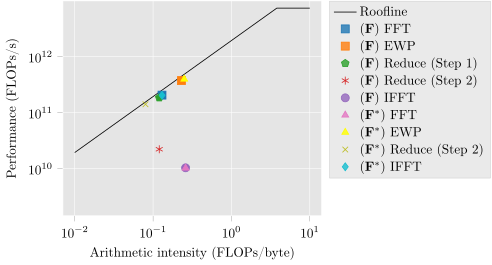
85-95% memory bandwidth utilization on all kernels1
1Kernels below roofline are caused by small input size and correspond to < 1% of runtime. Profiled with NSight Compute.
Single-GPU Performance
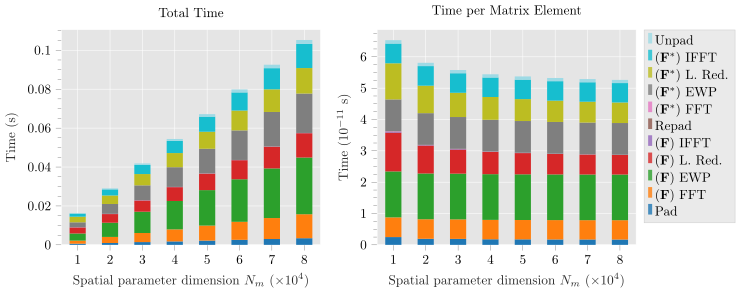
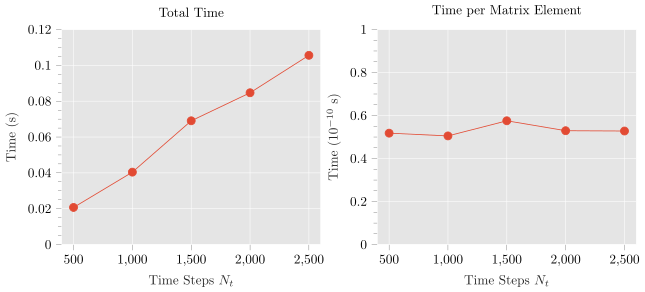
Single-GPU Performance
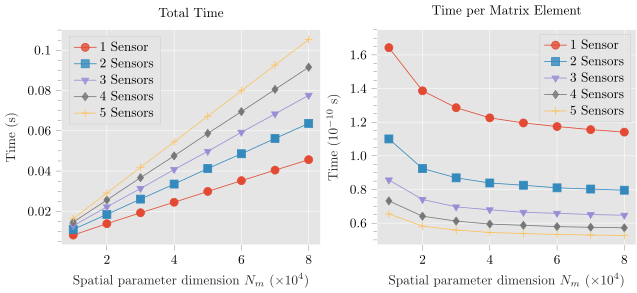
Single-GPU Performance
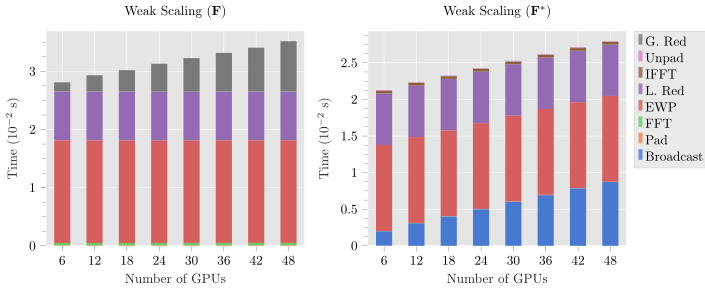
Weak Scaling
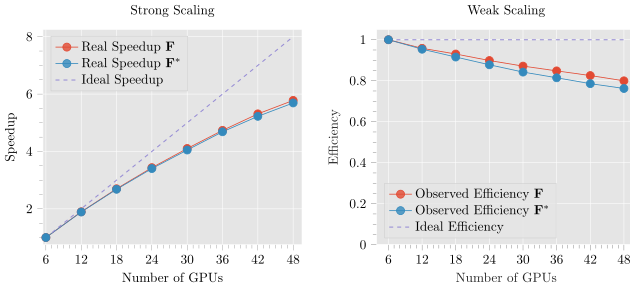
Weak and Strong Scaling
Conclusions
Fast matvecs with \(\mathbf{F}\) and \(\mathbf{F}^*\) enable real-time inference
Timeframe goes from hours to < 1 second!
Other applications: treaty-verification, CO2 monitoring, contaminant transport
Thank You!
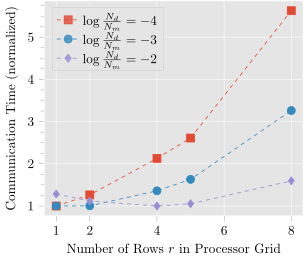
Communication-Aware Partitioning
2D Partitioning: \(p = r\times c\) grid of GPUs
Goal: Minimize communication costs
Data-to-Parameter Ratio \(N_d/N_m\) is key
Cost Function:
\(C(r;p,N_d/N_m) =
\)\(\frac{N_d}{N_m}\frac{1}{r}\log\frac{p}{r} + \frac{r}{p}\log r\)
Communication-Aware Partitioning
Cost Function:
\(C(r;p,N_d/N_m) =
\)\(\frac{N_d}{N_m}\frac{1}{r}\log\frac{p}{r} + \frac{r}{p}\log r\)
Algorithm (\(k\) GPUs/node)
- Compute \(\tilde{r} = \arg\min_r C(r;p,N_d/N_m)\)
- If \(\tilde{r} = 1\text{ or } p,\) use \(r = \tilde{r}\)
- Else, choose \(r\in \mathbb{Z}\) close to \(\tilde{r}\) so that \(r,\frac{p}{r} \in \mathbb{Z}\)
- Try to ensure \(k|r\) and \(k|\frac{p}{r}\) (on-node vs. off-node)
Communication-Aware Partitioning
Real-Time Inference
Sherman-Morrison-Woodbury applied to \(\Gamma_{\text{post}}\):
\[ \begin{gather} \Gamma_{\text{post}}=\left(\mathcal{F}^* \Gamma_{\text{noise}}^{-1} \mathcal{F} + \Gamma_{\text{prior}}^{-1}\right)^{-1} \nonumber\\ =\Gamma_{\text{prior}}\left(I - \mathcal{F}^*\textcolor{BF5700}{\left(\Gamma_{\text{noise}} + \mathcal{F}\Gamma_{\text{prior}}\mathcal{F}^*\right)}^{-1}\mathcal{F}\Gamma_{\text{prior}}\right) \nonumber \end{gather} \]
\(\textcolor{BF5700}{\mathcal{K} = \Gamma_{\text{noise}} + \mathcal{F}\Gamma_{\text{prior}}\mathcal{F}^*}\)
Dense Matrix of size \(\sim 10^6\times 10^6\)
\(\Rightarrow\) Compress
Real-Time Inference
\[ \begin{gather} \mathbf{m}_{\text{MAP}}=\Gamma_{\text{prior}}\left(\mathbf{I} - \mathbf{F}^*\textcolor{BF5700}{\mathbf{K}}^{-1}\mathbf{F}\Gamma_{\text{prior}}\right)\mathbf{F}^*\Gamma_{\text{noise}}^{-1}\mathbf{d} \nonumber \end{gather} \]
Operations
\(\left(N_m \sim 10^6, N_d \sim 10^2, N_t \sim
10^4\right)\)
- \(2 \ \mathbf{F}^*\) matvecs — \(\mathcal{O}(N_dN_mN_t)\)
- \(1 \ \mathbf{F}\) matvec — \(\mathcal{O}(N_dN_mN_t)\)
- \(1 \ \textcolor{BF5700}{\mathbf{K}}\) solve — \(\mathcal{O}\left(N_d^2N_t^2\right)\) worst case
- \(2 \ \Gamma_{\text{prior}}\) solve — \(\mathcal{O}(N_mN_t)\)
Real-Time Inference
\[ \begin{gather} \mathbf{m}_{\text{MAP}}=\Gamma_{\text{prior}}\left(\mathbf{I} - \mathbf{F}^*\textcolor{BF5700}{\mathbf{K}}^{-1}\mathbf{F}\Gamma_{\text{prior}}\right)\mathbf{F}^*\Gamma_{\text{noise}}^{-1}\mathbf{d} \nonumber \end{gather} \]
Pointwise Variance \((\text{diag}(\Gamma_{\text{post}}))\) can be precomputed with stochastic estimators
Villa, Umberto, Noemi Petra, and Omar Ghattas. "HIPPYlib: an extensible software framework for large-scale inverse problems governed by PDEs: part I: deterministic inversion and linearized Bayesian inference." ACM Transactions on Mathematical Software (TOMS) 47.2 (2021): 1-34.